Specialist Dry Ice Cleaning
Industrial cleaning — without water, abrasives or unnecessary downtime.
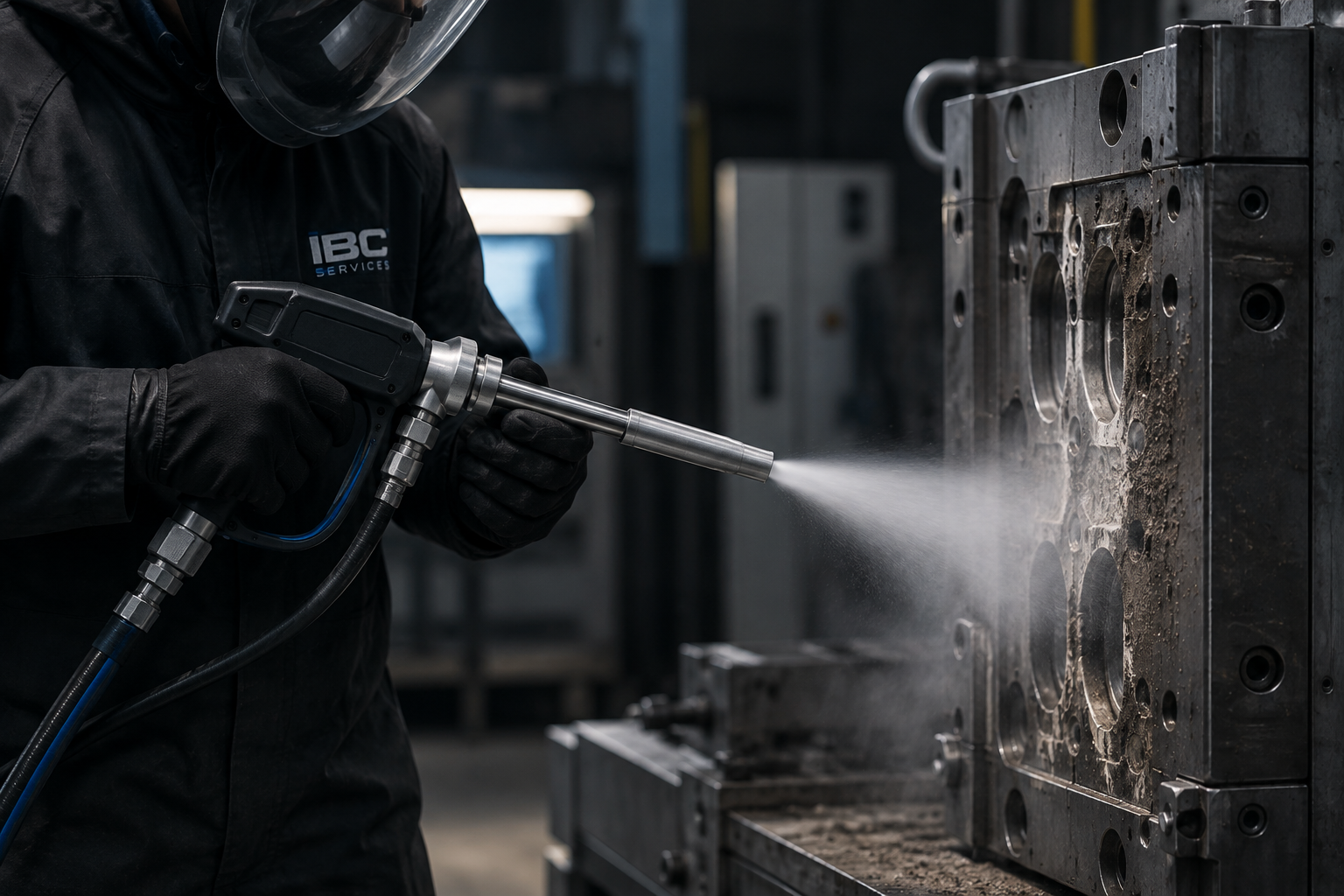
IBC provides specialist dry ice blast cleaning for industry across South Wales and the UK, removing contamination from critical equipment while it stays in place, where the application allows.
Precision. Power. Purity.
About IBC
A specialist industrial cleaning service.
IBC (Ice Blast Cleaning) is a dry ice cleaning specialist based in Bridgend, South Wales, operating as a division of Jewell Contractors. We clean industrial machinery, production equipment and structures using dry ice blasting — a controlled, dry process that lifts contamination without introducing water or abrasive media.
Our work supports manufacturers, engineers, food producers, restoration specialists and facilities teams who need equipment cleaned to a high standard with minimal disruption to production. Every project begins with an assessment of the surface, the contamination and the environment, so the method is matched to the task.
The Method
What is dry ice blasting?
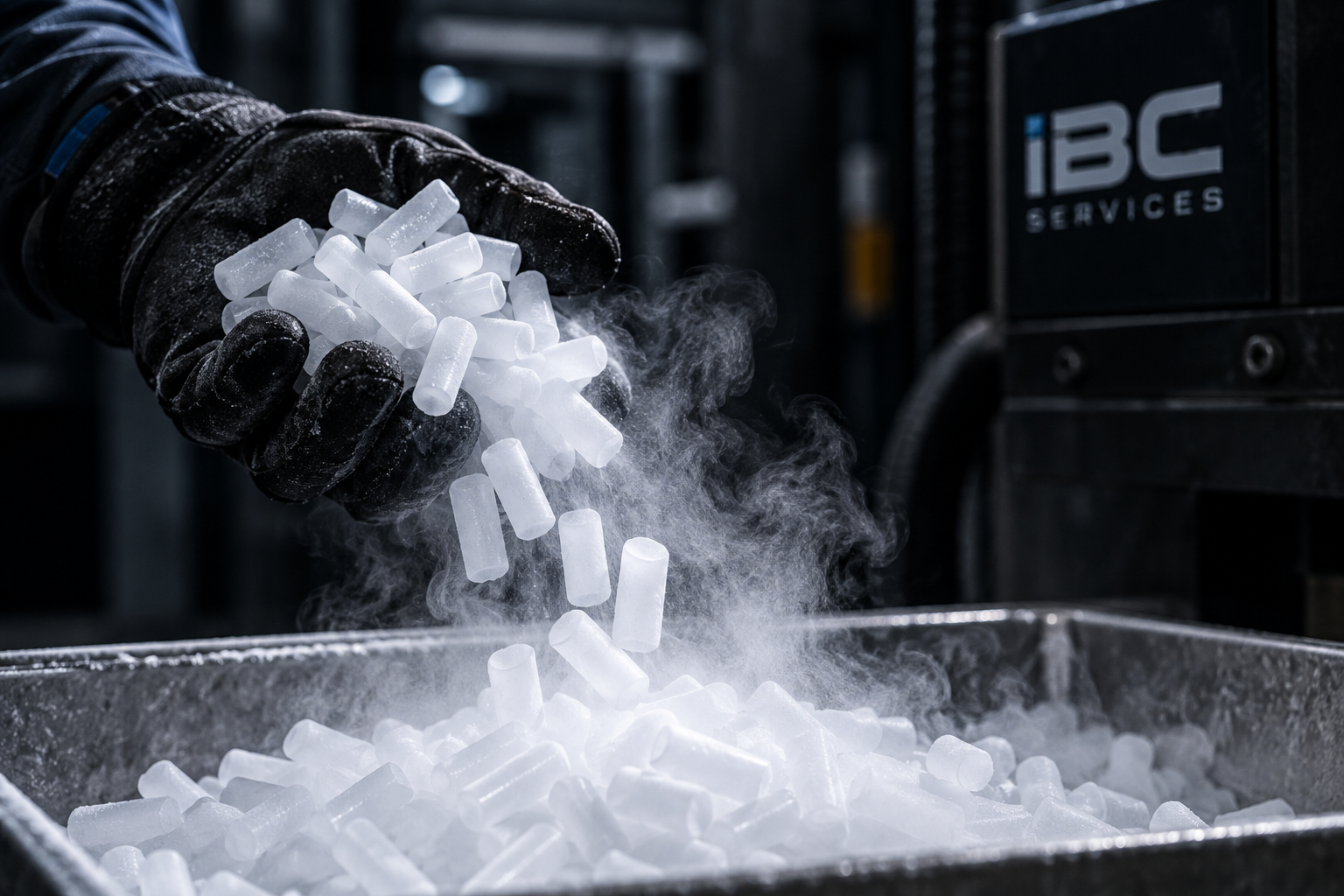
Dry ice is solid carbon dioxide, held at approximately −78.5 °C. It is formed into small pellets and accelerated through a specialist nozzle using compressed air.
Unlike water, chemical or abrasive methods, dry ice does not melt into a liquid. On impact it sublimates — passing directly from solid to gas — so it leaves no blasting media behind. What remains is the contamination that has been removed, and nothing else. That makes it a dry, non-abrasive process, suited to equipment where water, grit or solvents would create problems.
How It Works
Three mechanisms, working together.
Impact
Pellets strike the surface with kinetic energy, breaking up and loosening surface contamination.
Thermal shock
The extreme cold chills the contamination layer rapidly. The temperature difference weakens the bond between the contamination and the surface beneath.
Sublimation
As each pellet turns to gas it expands sharply, helping to lift loosened material clear of the surface, without leaving residue.
Advantages
Why businesses choose dry ice cleaning.
No water introduced
Suitable around equipment where moisture is a concern, following assessment.
No secondary blasting media
Nothing like grit or soda to collect and clear afterwards.
Reduced chemical use
Many tasks can be completed without solvents.
Less secondary waste
Only the removed contamination needs clearing.
Reduced downtime
Cleaning in place is often possible, with less dismantling.
Precision and control
Settings are adapted to the surface and the level of contamination.
Outcomes depend on the surface, the contamination and correct set-up. Each application is assessed beforehand.
Surfaces & Applications
Surfaces and applications.
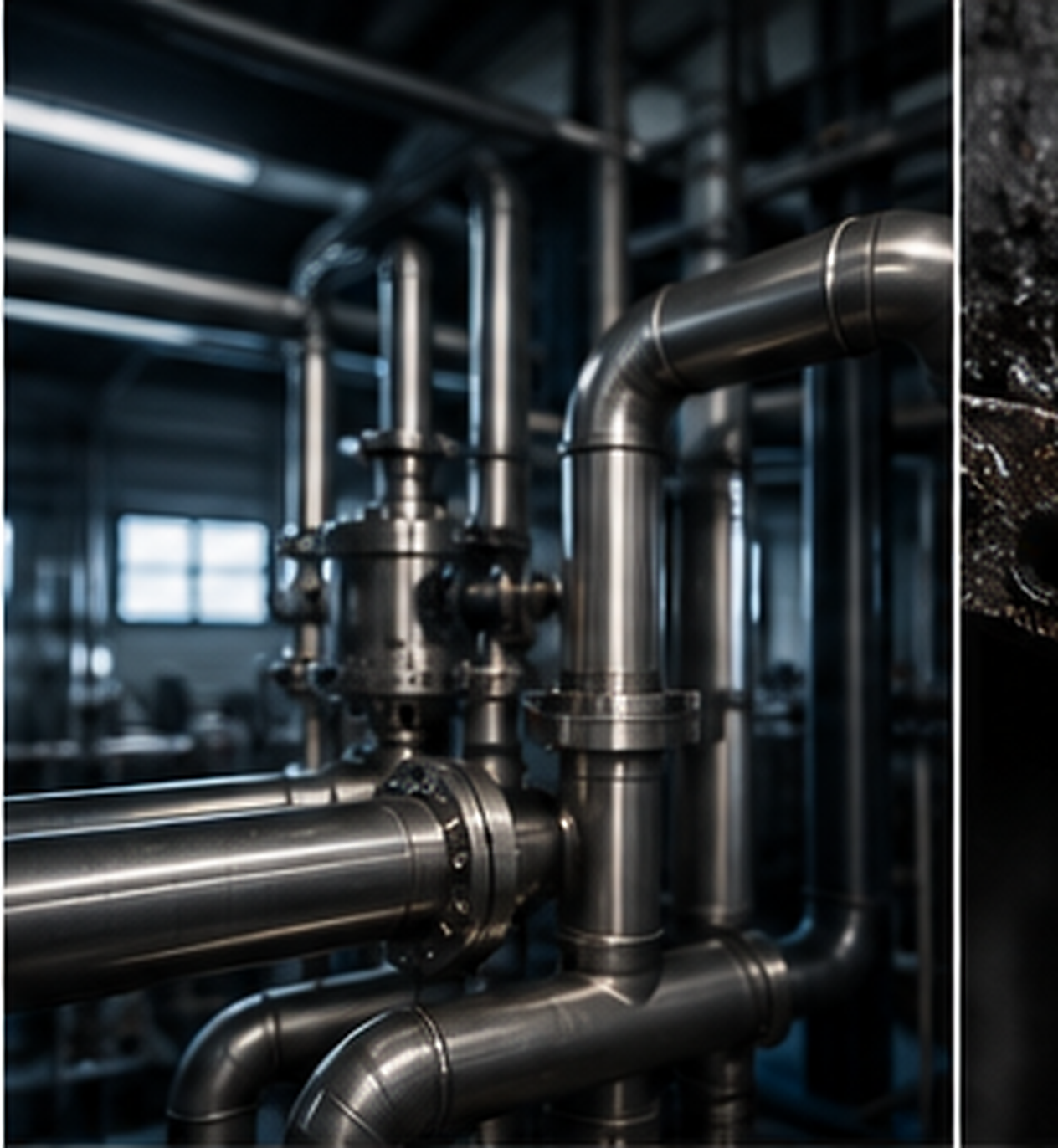
Dry ice cleaning suits a wide range of materials and contamination, provided the surface and the task are assessed first.
Surfaces
- Industrial machinery
- Steel and stainless steel
- Aluminium and cast components
- Moulds and tooling
- Electrical and electromechanical equipmentDe-energised, following assessment.
- Stone and masonry
- Painted and coated surfacesWhere the coating is to be preserved, with the correct settings.
- Food-production equipmentSubject to customer hygiene requirements.
Contamination removed
- Oil and grease
- Production residue
- Carbon deposits
- Release agents
- Mould contamination
- Fire and smoke contamination
- Selected coatings
- Graffiti
- Restoration contamination
Suitability varies by material and coating. Following assessment we confirm the right approach — or advise where dry ice is not the best method — before work begins.
Industries
Built for industry.
From heavy manufacturing to critical infrastructure, we work across sectors where equipment must be cleaned to a high standard with minimal disruption.
- Manufacturing
- Food & Beverage Processing
- Automotive Manufacturing & Restoration
- Marine & Offshore
- Power Generation
- Graffiti & Surface Restoration
- Aerospace
Automotive
Automotive cleaning & protection.
For automotive work, IBC can provide dry ice cleaning as a standalone service or as part of a combined cleaning and corrosion-protection package.
Dry ice cleaning can be used to remove accumulated dirt, grease and contamination from suitable underbody and mechanical areas without introducing abrasive blasting media.
Following cleaning and assessment, Lanoguard can also be applied as a protective treatment. Lanoguard is a lanolin-based underbody and chassis coating designed to form a flexible, transparent barrier that helps reduce exposure to moisture, road salt and dirt while allowing the condition of the underlying surface to remain visible.
Lanoguard states that its vehicle treatment can provide protection for up to 12 months, with annual top-up recommended.
Combined dry ice cleaning and Lanoguard packages are available upon request.
Assessment
Project assessment and control.
Dry ice cleaning is highly dependent on the surface, contamination and site conditions. Before work begins, we assess the substrate, the condition of any coating, the type of contamination, access, ventilation and production requirements. Equipment settings, pellet flow and nozzle selection are then matched to the application.
This assessment determines the cleaning method, equipment set-up and site controls used for the work.
Factors we assess
- Substrate and condition
- Contamination type and bond
- Coating condition
- Equipment set-up
- Pellet flow
- Nozzle selection
- Access
- Ventilation
- Nearby equipment
- Production requirements
- Acceptable downtime
- Required finish
Comparison
Before & After
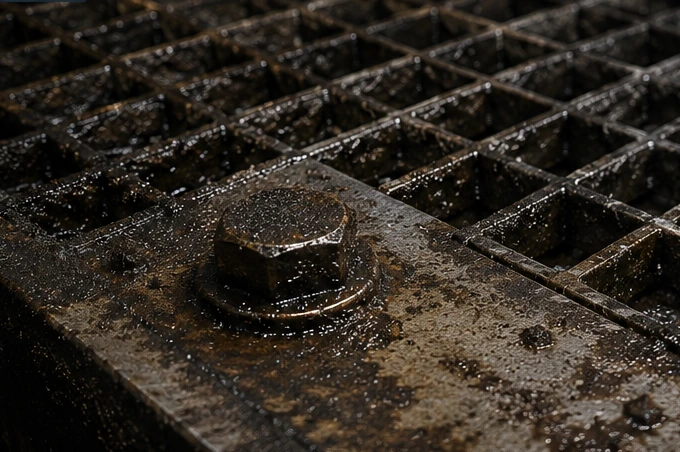
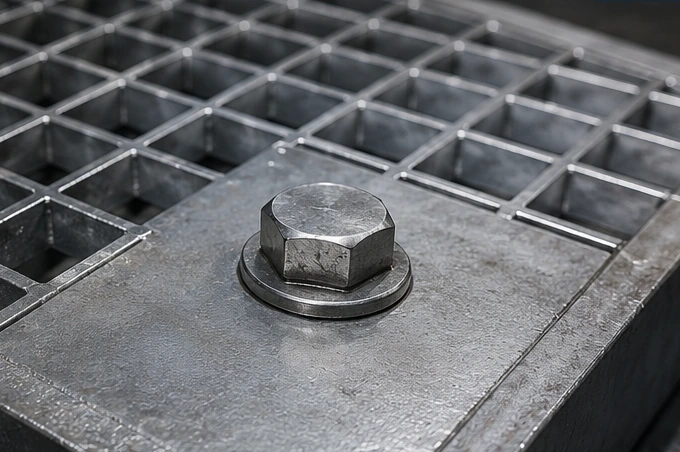
The comparison below shows dry ice cleaning carried out by IBC. Drag to reveal the result.
Capability
Equipment matched to the work.
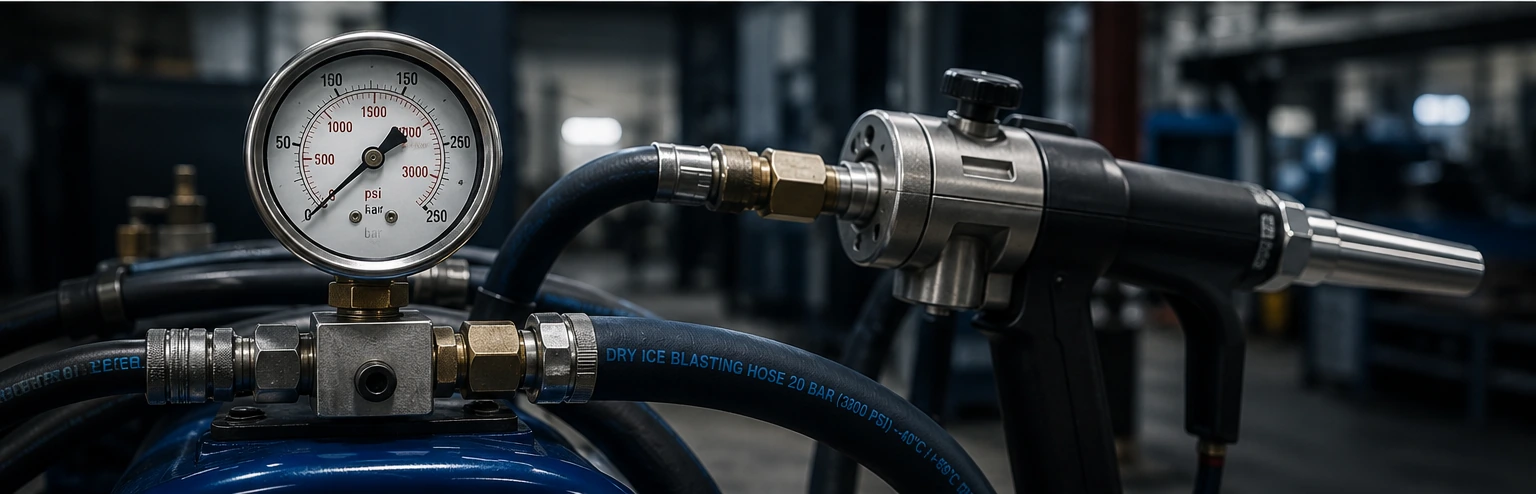
We operate professional-grade dry ice blasting equipment, including the CryoGen system, giving our operators fine control over pellet flow, pressure and nozzle selection. That control allows the process to be adapted to different surfaces and levels of contamination, rather than applying a single fixed setting.
The Process
Controlled, every step.
Every surface is different. We assess the material, contamination and environment before a single pellet is used. The result is controlled cleaning without unnecessary abrasion, chemicals or dismantling.
Assessment
We review the surface, contamination and site conditions, and confirm whether dry ice is the right method.
Set-up
We protect surrounding areas, arrange air and pellet supply, and configure the equipment for the task.
Controlled cleaning
We clean methodically, adjusting settings to the surface and contamination as we go.
Final inspection
We check the result against the standard agreed at assessment.
On-Site Footage
On Site
What a project needs on site.
- Compressed air of sufficient supply for the equipment
- Dry ice pellet supply, arranged for the work
- Electrical access where required
- Adequate ventilation, particularly in enclosed areas
- CO₂ monitoring where the environment requires it
- Site access for equipment and operators
Contact
Discuss a project.
Tell us about the equipment, the contamination and the outcome you need. We’ll advise whether dry ice cleaning is the right approach and, where it is, how we would carry out the work.
- Anthony – 07375 615990
Christopher – 07938 762445 - info@jewellcontractors.com
- Bridgend
South Wales - Nationwide coverage.